
‘Elizabeth Cady Stanton’ Review: A Tireless Advocate
Stanton was among the loudest of 19th-century suffragists. Her strong views sometimes put her at odds with her allies.
To view the full article on the WSJ website, click here.
By Meghan Cox Gurdon
Feb. 27, 2026 11:13 am ET
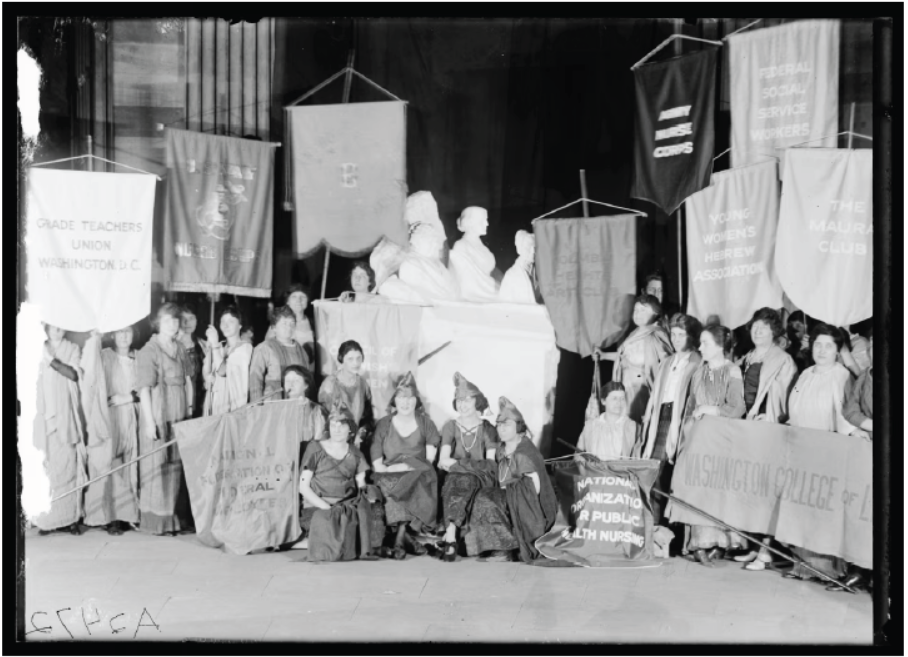
Women’s groups with a monument to the suffragists Elizabeth Cady Stanton, Susan B. Anthony and Lucretia Mott, ca. 1921-23.
LIBRARY OF CONGRESS
Elizabeth Cady Stanton (1815-1902) was an enthralling speaker, a sparkling writer and a passionate champion of temperance, abolition and, most importantly, women’s rights. She co-organized the 1848 Seneca Falls Convention, the first women’s-rights conclave in the United States; she was the first American woman formally to run for national office and the first suffragist to lead a delegation, made up of her comrades, before a committee of Congress. She was the boon companion of the women’s-rights activist Susan B. Anthony, and she could count among friends and allies the abolitionist Frederick Douglass.
The past loved and esteemed her. To the future, she became an embarrassment.
As Ellen Carol DuBois relates in “Elizabeth Cady Stanton,” her subject was appalled to realize that, after the Civil War, men of unexalted background were destined to get the vote before educated women like her. Never one to choose anodyne language, Stanton said it would be humiliating for women to have to plead for their rights to “serfs, peasants, plantation slaves, paupers knaves drunkards all the ragged ignorant foreign and native riff raff in the country.”
At the time, and among her contemporaries, there was nothing very extraordinary about her sentiments. It was not an egalitarian age. And when you are fighting for your cause and your people, you don’t want others, who are also fighting for theirs, to win before you do. (Even Douglass was irked by the idea that Irishmen and Native Americans should be considered sufficiently civilized to vote.) The only extraordinary thing at the time about Stanton’s words was their tartness. But she was white and she was criticizing black people and immigrants, and that is something that, though she could not have known it, the future would not abide.
“Her words are shocking to modern readers,” Ms. DuBois writes in this fine and necessary account of “a revolutionary life,” as the book’s subtitle has it. Ms. DuBois, a feminist scholar and professor of history at University of California, Los Angeles, pulls Stanton’s reputation out of the mud by putting her words and actions into historical context. In doing so, she rights a great wrong.
Stanton is a huge and consequential personage in American history, but she has dwindled in the eyes of posterity to become a subordinate of Anthony. The two women were as close as close friends could be, collaborating in a thousand ways, including on a multivolume history of women’s suffrage, though their personal lives and some of their ideas did not align. Stanton enjoyed what appears to have been a happy marriage to Henry, an abolitionist attorney and journalist who was 10 years her senior.
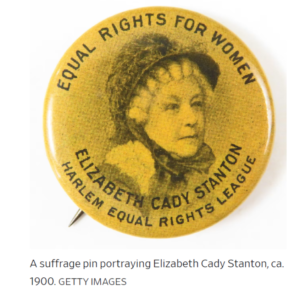
She bore and raised their seven children, several of whom followed in her professional footsteps. Anthony never married, and she considered herself to some degree Stanton’s amanuensis, confiding to an intimate that she felt that her best work had been “making the way clear” for her friend. Yet today even many who have studied U.S. history may not be able to tell you much about Stanton, for in her lifetime she committed a different crime: She stuck around too long, and it got on people’s nerves.
Into her ninth decade, Stanton was still writing and speaking and running meetings. According to Ms. DuBois it is difficult to pinpoint when and why the movement to which she had devoted most of her life began shrugging her off , but it did. One reason, surely, is that Stanton sought to take suffragism to a place it did not want to go.
Though raised a Calvinist, in later life she became convinced that American women owed their secondary status to the teachings of Christianity. She was instrumental in producing a Woman’s Bible, which omitted (and supplied commentary for) passages she disliked. At worst it seemed the project of a crank, at best an irrelevancy.
The rising cohorts of women’s-rights campaigners bore less of an imprint of the orthodox Protestantism than those of Stanton’s generation and had no interest in editing the Bible. If it is the fate of all men to be eclipsed by time, it is the special fate of the reformers of the day to be swamped by the incoming tide of tomorrow.
Young Elizabeth started life in upstate New York in a prominent family marked by loss: Six of her siblings (and all her brothers) died before reaching adulthood. Her father was a politician, lawyer and judge, and from him she learned reverence for the law. A “smart, energetic young girl,” in Ms. DuBois’s words, the future Mrs. Stanton was a natural rebel who hated being told “no.” Throughout her life, “if she was forbidden to do or say something,” we read, “her fi rst impulse was to do it anyway.”
Stanton developed a youthful interest in the temperance movement—for a while she wrote for a newspaper run by Amelia Bloomer, a temperance advocate (and eventual clothes-reformer)—before transferring her energies to abolitionism and thence to the cause of women’s enfranchisement. As a young mother, she rejected traditional medicine in favor of homeopathy, then thought to be a form of quackery. Her “embrace of homeopathy fitted with her other burgeoning reform enthusiasms,” Ms. DuBois observes. “Homeopathy’s hostility to male doctors’ arrogant assertion of entitled expertise blended well with her women’s rights convictions.”
As life went on, Stanton got well into the intricacies of movement politics: meetings, rivalries, lectures, tactical disputes, the waxing and waning of public support. For the historian or biographer, such details are inescapably important; for the lay reader, they can become wearisome. Ms. DuBois cannot be faulted for recounting the ebb andfl ow of 19th-century reform campaigns, and she does it well. The funny thing is that even Stanton found the bureaucracy all a bit too much.
At 61, she took off for Europe, later writing that she hoped perhaps with an ocean between her and Anthony, “I should hear no more of calls, conventions, appeals or petitions.” Of course it was not to be. Stanton lived another quarter-century, campaigning busily throughout. In an era when the very concept of womanhood is bizarrely contested, Ms. DuBois has done a great service to history by redeeming the name of this forceful, sensible and tireless women’s advocate.
—
Mrs. Gurdon is a Free Expression columnist at WSJ Opinion and the author of “The Enchanted Hour: The Miraculous Power of Reading Aloud in the Age of Distraction.”
To Download a PDF Version Click here
